Capnometry & fNIRS Application User Guide
Contents
- Introduction & Launching the Application
- Parameters
- Working with the Capnometry & HRV Application (User Interface)
- Breath Counting Functionality
- Report Functionality
Introduction
This guide introduces the Capnometry & fNIRS biofeedback application, part of the Mind-Body Training Tools suite. MBTT applications are designed to train self-regulation skills, which I sometimes call mind-body skills.
The guide has two purposes: firstly to give an overview of capnometry biofeedback, and secondly to teach you how to use the software – though it is more of a reference than a tutorial.
The capnometry module applications are designed to train optimal breathing. A capnometer measures end-tidal carbon dioxide in exhaled air, which is known to correlate with the level of carbon dioxide in blood. The latter is an important physiological parameter, as it controls vasodilation, most prominently in the brain. Over-breathing or hyperventilation causes depletion of blood carbon dioxide and thus restriction of oxygen delivery to brain cells, while conversely capnometry biofeedback is a means of training optimal oxygen delivery to brain cells.
In this application the secondary parameter is HRV (Heart Rate Variability). More specifically we are looking to train Heart Coherence, quantified as the Heart Coherence Score or Heart Rate Coherence Score. Heart Coherence is a state where heart rate rises and falls in sync with the breath - the larger and the more consistent these swings in heart rate, the more coherent we consider the heart to be (and thus the higher the HRC Score).
Breathing at a slow and steady rate is a way of maximising heart coherence. The state of heart coherence is in some sense a state of optimal functioning - for example it is associated with more positive mood states and also with states of meditative concentration.
Thus you see how combining capnometry with heart coherence training is potentially a powerful form of breathing training.
The guide assumes that you already have a basic knowledge of how to work with Mind-Body Training Tools software. If not, I suggest you read this Introductory Guide to Working with MBTT.
Launching The Application
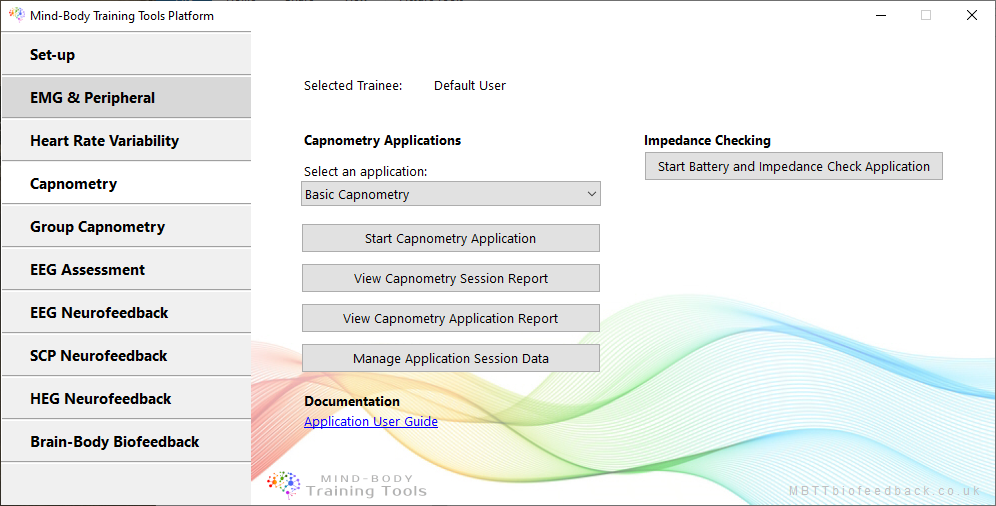
To launch the application (after starting the platform program) first click on the "Capnometry" tab, then select the "Capnometry & HRV" application from the drop-down list, then click the button to launch the app.
Parameters
There are three input parameters in the Capnometry & fNIRS app, firstly partial pressure of carbon dioxide, hereafter PP CO2, which is explained more fully in this article about capnometry and breathing measurement, and secondly heart rate, and thirdly the fNIRS or HEG signal.
From this signal, the application calculates the following feedback parameters:
- End-tidal PP CO2 - the peak heights of the breathing trace. This is the key physiological measure from the capnometer signal.
- Breathing Rate
- Heart Rate Coherence Score, which is derived from the changes in heart rate in relation to the turning points of the breath. (This guide explains how MBTT quantifies heart coherence.)
Working With The Capnometry & HRV Application (User Interface)
The MBTT apps have a common design scheme. The intent is that learning to use one app, can be generalised so that other apps in the suite are easy to learn.
The apps generally have three windows:
- Main window, or trainer's window, containing parameter charts
- Threshold window - each app has at least one threshold, but there are usually more.
- Feedback window - in a sense, all charts and thresholds are giving feedback, but the feedback window contains controls for audio feedback plus more specialised feedback forms.
Main Window
The main screen looks like this:
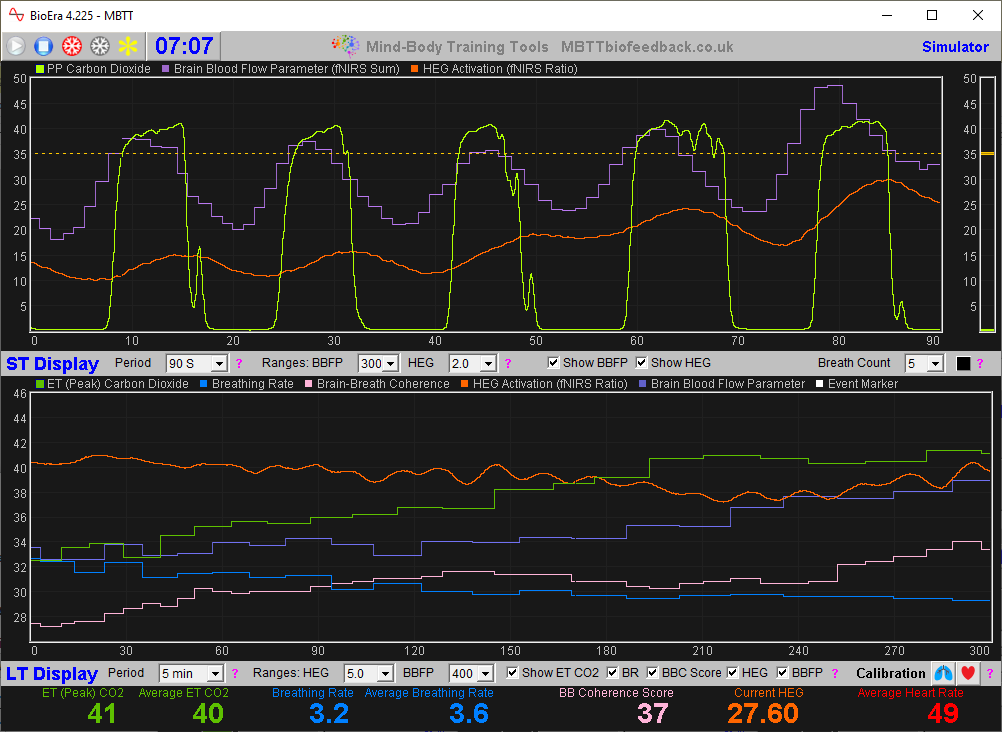
The following video offers a tour of the Capnometry & fNIRS app UI. TO_DO
Thresholds
In biofeedback, physiological parameters are mapped into visual or auditory form, so that the trainee can perceive changes directly through his senses. Feedback can be continuous and proportional to the parameter, for example a tone whose pitch and/or volume varies with the parameter, or it can be discrete and dichotomous, for example a bell sounds whenever muscle tension rises above some limit.
Thresholds are the means of configuring the mapping, meaning they define how much of the parameter results in how much feedback.
The Capnometry & fNIRS app has four thresholds, shown here:
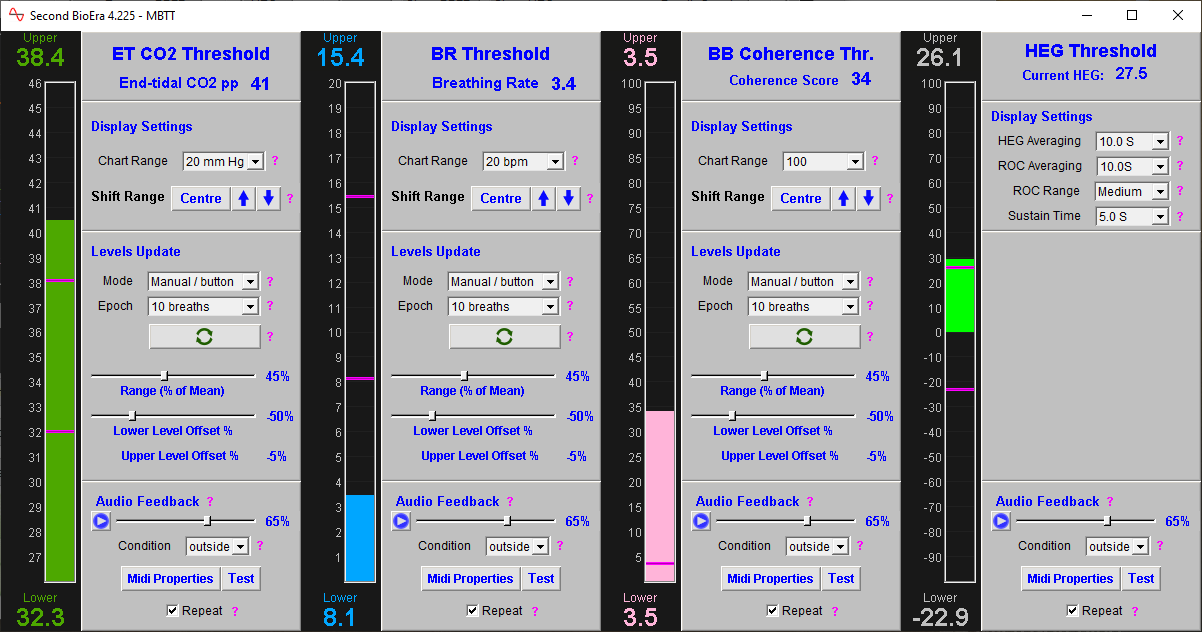
The thresholds have two levels, which define the maximum and minimum amounts of feedback (for example the max and min volume). Setting the levels appropriate is key to effective biofeedback training.
This Guide to Working With Thresholds in MBTT describes the principles of thresholding in greater detail, and explains how you can set and update the levels, either automatically or by hand.
The simplest way to update threshold levels is “by hand” or by dragging them with your mouse, but you can also use automated methods to compute and update the levels. All the thresholds in the Capnometry & HRV app have threshold calculation based on means (as described in the above guide) and they all use an epoch based on a number of breaths.
Audio Feedback
The application offers midi feedback and threshold-based contingent audio feedback. Additionally, you can transmit feedback parameters out of BioEra, for use with external feedback applications. Please note that the Breath Player utility, which is part of the MBTT Platform program, cannot be used with the capnometry apps (except in breath pacer mode) because.
Threshold-Based Audio Feedback
To recap, the basic concept is that the software plays a sound (actually a midi note) whenever a threshold limit (level) is crossed.
The controls for threshold based feedback are found at the bottom of the threshold controls. There is a button to activate it / turn it off. A drop-down control sets the condition or contingency: for example if set to “above”, the feedback will sound whenever the parameter exceeds the upper level. “Below” means it sounds below the lower level, and “outside” means it sounds for either of these two.
You can change the midi “instrument”, and you can have the sound repeat for each breath that meets the threshold condition, or only the first time the level is crossed.
Audio Feedback Window
The controls for audio feedback, aside from the threshold-based audio feedback discussed above, are found in a separate window shown below:
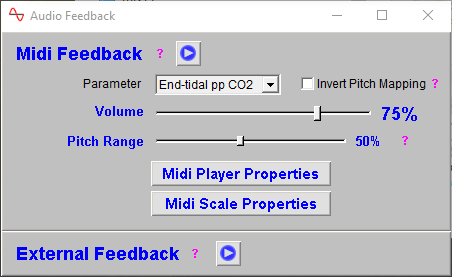
In midi feedback, a musical note is played whose pitch varies with the selected feedback parameter. You can select which parameter to use as the basis of feedback using a drop-down list control, and you can invert the pitch mapping if you wish, so that a higher reading produces a lower tone.
Audio feedback is demonstrated in the following video TO_DO.
Breath Counting Functionality
In keeping with other applications which measure breath, the Basic Capnometry app offers breath counting functionality. This is useful in a context of meditation practice (with breath as the object of focus) where the trainee counts breaths up to a target of say, ten. Distraction and mind-wandering cause the you to lose count, and perhaps to lose awareness of the breath completely. The user presses the space bar to start a count, and then again when the target is reached. The software tracks the breath count too, but is not prone to distraction, and thus can assess the trainee's performance.
Breath counting functionality is discussed in more depth in the Guide to Working with MBTT Apps.
Report Functionality
Mind-Body Training Tools allows you to generate session reports and application reports.
The controls for report generation are found in the platform window, in the Capnometry tab shown towards the beginning of this document. You need to have selected the right application from the drop-down list - in this case Capnometry & HRV.
A session report shows charts and tables for the feedback parameters summarising the whole session. You'll be asked to select one particular session, and given report options. The options dialog looks like this:
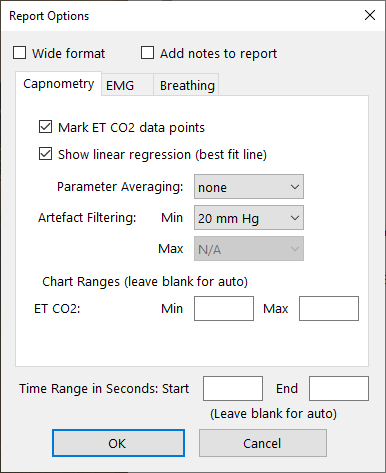
The application report shows the variation of the feedback parameters across multiple sessions. Typically for each feedback parameter, the software generates line charts for session means, session maxima and session minima.
Report functionality is described in greater depth here.
You can see sample reports here:
Sample Capnometry Session Report
Sample Application Report (not a capnometry application).