What Is Neurofeedback & How It Can Boost Emotional Well-being & Cognitive Performance?
Neurofeedback is a form of brain training aimed at improving brain performance and thereby such functions as:
- executive function: attention, focus and concentration, also impulse control and self-organisation
- emotional self-regulation or emotional resilience
- motivation, willpower and energy
Neurofeedback is a form of biofeedback, which means we measure some aspect of physiological functioning, and feed back changes in real time via computer, as a basis for learning to influence the underlying physiological functioning towards healthier states more supportive of well-being and optimal performance.
Neurofeedback differs from peripheral biofeedback insofar as we directly measure brain activity rather than something "down stream" of the brain, like muscle tension. Most neurofeedback is based on EEG or brain waves, but in principle any measure of brain activity could be used, such as fMRI as described in this video clip from a talk by neuroscientist Dr Judson Brewer.
In a study that asked if neurofeedback could support meditation practice, Dr Brewer's team measured metabolic activity in a specific brain region called the posterior cingulate cortex (PCC), which has been linked to mind wandering, or self-referential mind chatter. The feedback to the meditators showed them when the PCC was active (red graph) and when it was quiescent (blue graph). The researchers hoped blue quiescent state, free of mind-chatter, would support meditation.
Unfortunately fMRI machines cost millions. EEG is much cheaper - as is another measure called hemoencephalography or HEG. (You can read more about HEG neurofeedback in this article.) HEG is based on a technique called fNIRS, which aims to monitor the same brain blood-flow mechanism as fMRI.
EEG is a measure of oscillating electrical voltage made at the scalp. The oscillations within EEG derive from rhythmic mechanisms operating within the brain that are thought to play a causal role in brain functioning. Thus, neurofeeback is a form of brain training that trains directly neurophysiological mechanisms, as opposed to other forms of brain training which train cognitive skills.
How Does Neurofeedback Create Positive Change?
We have no natural awareness of EEG or brain rhythms, as we do with say EMG (a peripheral biofeedback training parameter). Neurofeedback doesn't augment subjective awareness, as EMG biofeedback does, rather it works in a different way. Biofeedback can facilitate learning in at least three different ways:
- Offering insight into the mind-body connection and how it works to shape our feelings and thinking.
- Developing mind-body skills, or the ability to influence the mind-body connection.
- Building brain fitness, or a more adaptive nervous system, in the way that weight training develops muscles.
Neurofeedback fits more with the latter - learning is happening at an unconscious level and the conscious mind plays a much less significant part.
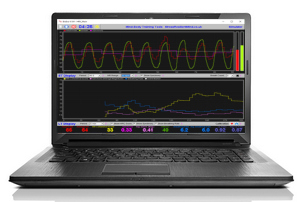
Mind-Body Training Tools
Biofeedback & Neurofeedback Software
A suite of applications covering a range of modalities, including HRV, capnometry, EMG and EEG
A More Detailed Look At How EEG Neurofeedback Works
There are many different forms of EEG neurofeedback. Mostly the differences lie at the level of the protocol: the decision as to what exactly within the EEG we wish to train, and where in the head we want to train it.
Most protocols train amplitude of some particular EEG band. What does this mean?
What Is EEG?
To repeat, EEG is an oscillating voltage - here is a sample:

Within EEG it's possible to distinguish rhythms of differing frequencies (cycles per second). They have names you've probably heard of, such as alpha, theta and delta. EEG is actually extremely complex - the component rhythms wax and wane often quite rapidly, and at any point in time a mixture is present. Furthermore, the make-up of EEG varies across the head.
The EEG bands (alpha, theta, etc.) loosely correlate with subjective experience:
- Delta rhythm is normally only present in deep sleep, but can be seen in some types of brain injury or depression cases.
- Alpha seems to be the brain's "idling rhythm", associated with relaxed awareness
- Theta is associated with an intuitive or dreamy processing style
- Beta is connected with awake thinking.
But beware of over-simplifying and over-interpretting EEG - the relationship to conscious experience is both loose and complex.
An EEG rhythm typically waxes and wanes over a period of seconds - that is to say, the amplitude of brain waves increases and decreases. To repeat, most EEG neurofeedback is amplitude training: we feed back the amplitude of some frequency band, and reward the brain for the sort of changes we want. The "goal" is to either increase or decrease this amplitude (produce more or less of they particular rhythm). For example, a commonly used protocol is to train alpha amplitude up (train the brain to produce more alpha rhythm).
Operant Conditioning: How Neurofeedback Supports Learning
Neurofeedback doesn't actively change the brain, it merely rewards or "congratulates" the brain when it spontaneously does something we want. Over time, with repeated rewarding, the brain learns to produce of the desired state - a process known as operant conditioning in psychology.
Feedback & Conscious Experience
Mostly the feedback doesn't seem to relate to your conscious experience, and moreover you can't consciously influence the feedback - the best strategy for the neurofeedback trainee is to allow the brain to learn for you automatically.
(That said, this isn't always true. Alpha rhythm in particular can often be both consciously recognised and produced at will, at least with some training.)
Choosing The Right Protocol
A key factor in the success of neurofeedback is selecting the most appropriate protocol for each individual trainee. Neurofeedback practitioners will typically start with some form of EEG assessment, looking for patterns that somehow correlate with problems or dysfunction. For example, people diagnosed with ADHD often (though not always) show more theta in the front of the head. In that case it makes sense to train theta amplitude down, in the front of the head.
This is a very brief sketch of how neurofeedback works. You can learn much more about neurofeedback in our practitioner training course.
Neurofeedback Professional Practitioner Training
- Add neurofeedback to your practice for better outcomes
- Attract new clients with cutting-edge tools
- *** PLEASE NOTE THIS PRODUCT IS STILL IN DEVELOPMENT AND NOT YET AVAILABLE ***
READ MORE ABOUT BIOFEEDBACK FOR STRESS MANAGEMENT
Mind-Body Intelligence
How To Manage Your Mind With Biofeedback & Mindfulness
Book by Glyn Blackett

- Underlying dynamics in stress & anxiety
- Science of the mind-body connection & how it can be applied
- Why breathing is at the heart of stress management
- Practical models for framing self-control challenges & solutions
WHAT MY
CLIENTS SAY
"The biggest improvement has been to my ability to focus and concentrate at work. I no longer fall asleep in afternoon meetings! Since seeing Glyn I have been able to maintain my focus, and my performance has definitely increased. The changes have been maintained since the therapy ended."
- Sam, North Yorkshire