About Capnometry & Breathing Measurement
Contents
- Introduction
- The Capnometer Biofeedback Signal
- Calculated Parameters
- Physiological Role of Carbon Dioxide
- Hyperventilation or Over-breathing
- Why ET PP CO2 Is Low in Over-Breathing & Not High
- Optimal Breathing
- Breathing Calibration
- Zeroing the Capnometer
Introduction
This article describes capnometry, a measure of breathing which is the basis of a number of the applications in the Mind-Body Training Tools suite. It gives background information for the application user guides.
A capnometer measures end-tidal carbon dioxide in exhaled air, or ET CO2. More precisely it measures the partial pressure of carbon dioxide (PP CO2) in exhaled air, which we can think of as concentration of CO2.
The device itself samples air from the nostril using a cannula. Hardware details are covered elsewhere (e.g. see this capnometer user guide).
PP CO2 is known to correlate with the level of carbon dioxide in blood. The latter is an important physiological parameter, as it controls vasodilation, particularly so in the brain. Over-breathing or hyperventilation causes depletion of blood carbon dioxide and thus restriction of oxygen delivery to brain cells, while conversely capnometry biofeedback is a means of training optimal oxygen delivery to brain cells.
Capnometry is considered to be the best way of objectively detecting over-breathing.
The Capnometer Biofeedback Signal
The figure below shows a typical PP CO2 trace as seen in MBTT capnometry applications.
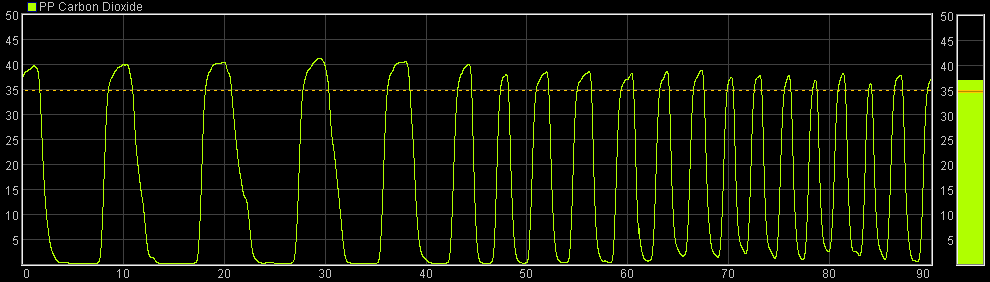
The figure shows the variation in PP CO2 with breathing – it rises to a peak during the exhalation phase of the breath. The height of this peak is key – it is known as the end-tidal partial pressure of CO2 (ET PP CO2) and is known to correlate with the blood level of CO2.
Calculated Parameters
From the PP CO2 trace, the software calculates:
- End-tidal (or peak) PP CO2 – once per breath
- Breathing Rate (in breaths per minute)
These two parameters are shown in the long term displays of the capnometry applications, and can be used as the basis of audio feedback.
Physiological Role of Carbon Dioxide
Although we think of carbon dioxide as a waste product, it has important functions in the body. Firstly, it controls the pH (acidity) of blood, which is a critical parameter because it dictates how the blood binds to oxygen and then releases it to tissues. Secondly, blood carbon dioxide influences vasoconstriction and vasodilation, most particularly in the brain where it is the main determinant.
These two factors together mean that partial pressure of carbon dioxide in the blood determines the oxygen delivery to brain cells.
Hyperventilation or Over-breathing
Hyperventilation or over-breathing is a common form of breathing dysregulation. It causes the partial pressure of carbon dioxide in blood to become depressed, resulting ultimately in reduced oxygen delivery to brain cells. Low carbon dioxide is known as hypocapnia. Hyperventilation can be acute or chronic, and has numerous associated symptoms.
Under-breathing, by contrast, is rare, and from a practical point of view is extremely unlikely in the absence of medical conditions affecting the lungs.
Capnometry is the best way of measuring over-breathing (which is a matter of degree). In over-breathing, ET PP CO2 is low.
Why ET PP CO2 Is Low in Over-Breathing & Not High
In over-breathing, too much CO2 is blown off, leaving a deficit in the system (i.e. the blood system). If there is too much CO2 in exhaled air, why is the reading too low and not too high? This question can confused a lot of people.
The measured parameter is a concentration of CO2, not a measure of the amount being exhaled. It correlates to the concentration of CO2 in the blood.
A useful analogy is a water tank - it has an outlet tap at the bottom and an inlet for new water at the bottom. If more water goes out than comes in, the level of water in the tank drops. Think of the ET PP CO2 parameter as like the level of water in the tank, not a measure of how much is coming out of the tank. Over-breathing means more is going out than coming in, and the level “in the tank” is dropping.
Optimal Breathing
Conversely, in optimal breathing ET PP CO2 is high, thus maximising blood CO2, and oxygen delivery to brain cells. (This assumes that there is no lung disorder making ET CO2 unnaturally high.)
Optimal breathing training aims to maximise ET PP CO2.
Optimal is not the totality of optimal breathing. This article gives a fuller account of optimal breathing.
Breathing Calibration
To calculate the above parameters, the software needs to accurately and consistently detect the turning points of the breath (beginnings of inhalation and exhalation). This calibration should happen automatically during the first minute or so of the biofeedback session. It's possible that sudden changes in breathing can cause the software to lose its calibration so that it no longer detects the breath turning points. You can tell this has happened because the breathing rate and ET PP CO2 no longer update for each breath – but it should be a very rare event. In such cases you can recalibrate the breathing by pressing a button, in the bottom left of the application's window, and shown below.

Zeroing The Capnometer
When there is no exhaled air flowing into the capnometer, the signal (PP CO2) should go to zero. You can see this happens in the figure above showing the PP CO2 trace, at least for the first few breaths (later the breathing is so rapid it doesn't have time). Sometimes this doesn't happen, and if you see that the trace hovers a few points above zero, you need to take steps to re-zero your device. In fact it's a good idea to do this every so often anyway, because if the signal drifts the other way, i.e. below zero, you won't see it.
In summary, the capnometer signal can drift over time, meaning the ET CO2 calculations are inaccurate. Zeroing a capnometer is in effect re-calibrating its signal.
In the MBTT capnometry applications, depending on your device, there may be a button that allows you to do this from within the software. It is found in the top-right corner of the main control window. An example is shown below.
At the time of writing this is only implemented for the “Respironics-compatible” device. For it to work properly, the device must be disconnected from the breath for a period of several seconds before clicking. When you click, you should see the trace disappear and the lamp turn red for a period of a few seconds. If this doesn't happen, wait longer.