Guide to Skin Temperature: Its Measurement & Role in Biofeedback Training
Contents
- Introduction
- Psychophysiological Basis of Skin Temperature Biofeedback
- Role of Skin Temperature Biofeedback in Stress Management Training
- Presenting Skin Temperature Biofeedback: ST Rate of Change
Introduction
Skin Temperature (ST) is one of the oldest biofeedback modalities. Although it's not the most in-vogue parameter, lots of evidence supports its efficacy in relaxation skills training.
In ST biofeedback, temperature is typically measured from the skin of a finger.
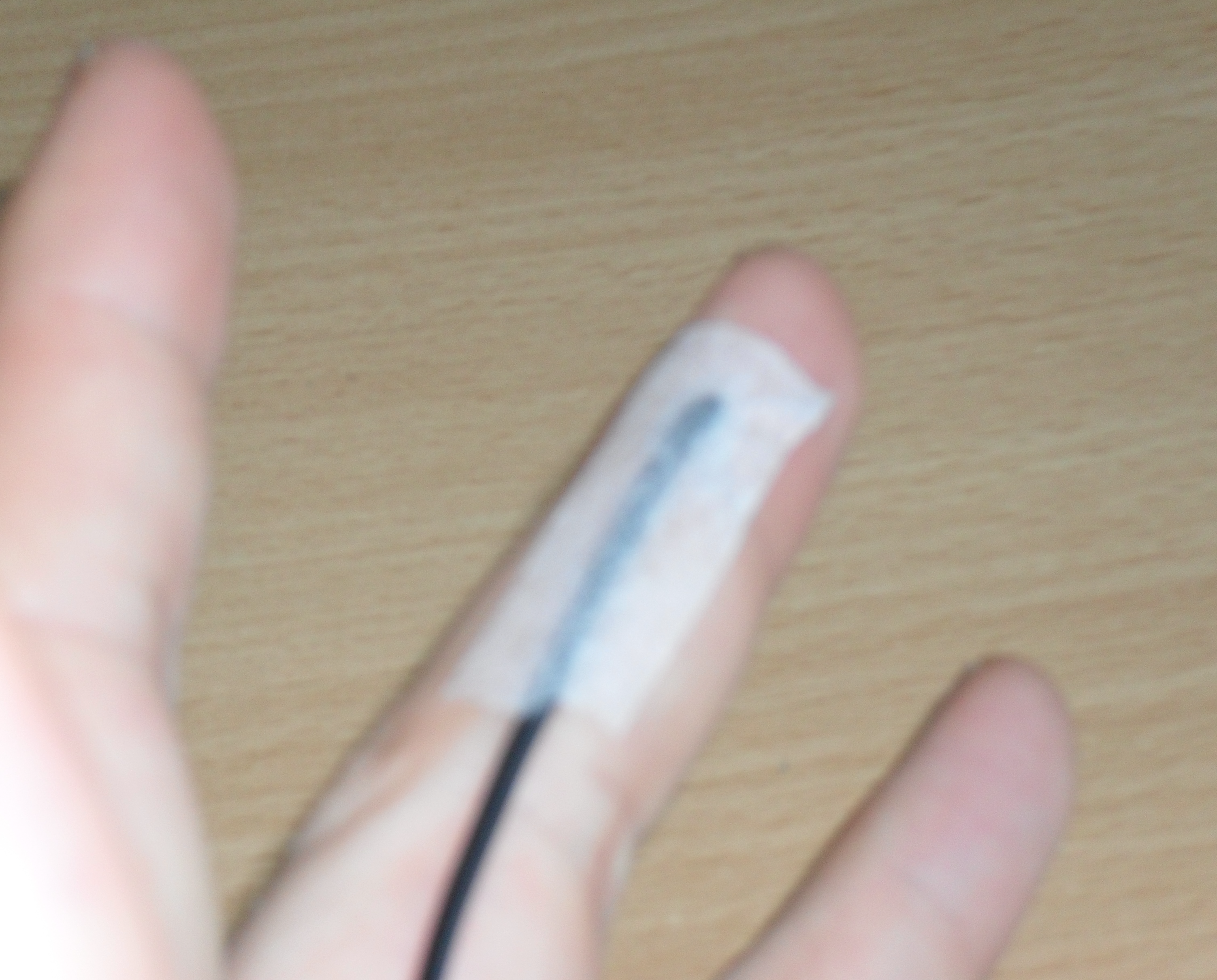
As with GSR biofeedback, we are interested in relative changes more than absolute values. These changes are the result of changes in blood flow, which is in turn mediated by the Autonomic Nervous System (ANS). At least, this is the source that's most relevant to relaxation training. You should keep extraneous influences to a minimum - for example if you've just finished a gym session, chances are you're going to be cooling down regardless of any changes in ANS activity.
This means it's best to train in a room with a stable and ambient temperature and without any draughts.
Under normal circumstances, relaxation induces greater blood flow in peripheral parts of the body like the fingers - so we are looking to train increases in ST.
The Psychophysiological Basis of ST Biofeedback
The temperature of the skin can change for many reasons, for example air flows in the room, or you've just come into the room from a different environment. In biofeedback training we are most interested in changes in blood flow. Other influencing factors should be excluded or minimised to make ST biofeedback training optimally efficient.
An increased volume of warm blood flowing in the peripheral vessels warms the skin tissue. Peripheral blood flow is in turn mediated by the Autonomic Nervous System (ANS).
The Autonomic Nervous System
The ANS is a part of the nervous system that governs many of our automatic and visceral responses. It has two branches, known as the sympathetic and parasympathetic nervous systems. These have opposite effects on the body, rather like the accelerator and brake in a car. The sympathetic increases the body's arousal level (it's the accelerator) while the parasympathetic lowers arousal (it's the brake). Some examples of effects of sympathetic arousal include increased heart rate and blood pressure, increased blood sugar levels, and a directing of the blood more towards the muscles. It's preparing the body for action – it's associated with the so-called “fight or flight” or stress response. Conversely the parasympathetic NS has effects such as lowering heart rate, blood pressure and blood sugar, and diverting blood more towards the digestive organs (it's known as the “rest and digest” response).
Many of our blood vessels have tiny muscles in their walls, which are under the control of the sympathetic NS. It is by contracting these muscles that the sympathetic NS is able to raise blood pressure and alter the pattern of blood flow. Blood vessels in the peripheral parts of the body, such as the fingers, particularly show this responsiveness to sympathetic NS activation. Reducing blood flow causes the finger skin temperature to fall.
The parasympathetic NS doesn't directly influence finger blood flow, but it does indirectly. To some extent, the SNS and PSNS work antagonistically, like two arms of a see-saw. When one is activated the other tends to be withdrawn.
Influences on the ANS
The question now is, what causes the ANS to activate either the sympathetic or the parasympathetic nervous systems?
The major influences of interest are emotions. The sympathetic or “fight or flight” response happens when we feel stressed – anxious, frustrated or angry. The parasympathetic response is an aspect of more positive emotion. We could sum it up as the relaxation response, which is of course what we are attempting to train in skin temperature biofeedback.
Another influence is body temperature regulation. The body needs to keep its temperature stable, and regulating peripheral blood flow via the ANS is a means of achieving this. For example if you go into a hot room, the body can increase its rate of heat loss by directing blood towards the surface of the skin. However we're not really interested in this. In fact, for skin temperature biofeedback we need a stable and ambient environment, so that we can assume that the temperature changes are indeed a reflection of emotional influences.
The Role of ST Biofeedback in Training
Humans don't have direct voluntary control over ST or the SNS, in the way that we do over say muscle movements. ST is of course used as a biofeedback parameter in the learning of relaxation skills, but the skill that the trainee needs to bring to bear is a kind of disengagement or letting go: the key is to not try.
(Of course in training relaxation you “want” ST to increase.)
The kind of attention needed is broad and open, as opposed to narrow or even “grasping”.
While willful effort seems to engage the SNS and decrease ST, imagination doesn't necessarily. Playfully imagining relaxation or visualising relaxing contexts such as a warm bath or being in nature, can be a successful strategy.
GSR vs. ST Biofeedback
Since both GSR and ST are mediated by the sympathetic NS, they share a lot in common as biofeedback parameters - but there are important differences too. The most significant difference is to do with time scale: SNS activation shows up in the skin conductance (SC) signal very much more quickly - after about a second - and much more clearly - as a sharp rise in the SC trace. The ST trace is much slower to respond, with changes happening more on a time scale of minutes.
The strength of GSR biofeedback is it's ability to show the trainee the nature of the mind-body connection: the immediate correlation between experience and body responses.
Skin Temperature biofeedback, on the other hand, tends to smooth out the volatility that we can see in the SC signal, and thus gives a more “averaged” impression of sympathetic / ANS activity. While GSR offers insights, ST may be better for training and skills development.
This topic is covered in greater depth in my Biofeedback Practitioner Training Programme.
Presenting ST Biofeedback: Skin Temperature Rate of Change
The absolute value of the ST reading itself is of little value – rather, it is changes in ST that count. For this reason it is useful to calculate the rate of change of ST. A biofeedback app might display both ST and ST rate of change. For example, decreasing ST (triggered by the sympathetic NS) gives a negative rate of change.
Here, the ST signal is shown on the left and the rate of change on the right.

When the left trace is heading upwards, the right trace goes above zero and turns green, while when the left heads down, the right trace goes below zero and turns red.