About Electromyography for Muscle Tension Measurement
Contents
What Is EMG?
EMG (an abbreviation of electromyography) is an electrical correlate of muscle tension measured from the skin. It's quite a complex measurement in some ways. For practical purposes all you need to know is this: you attach three sensors to the skin. Two of these are known as the active sensors. The software comes up with a number that reflects the muscle tension between the two active sensors. This number is changing from moment to moment – if you tighten up the number gets bigger, and if you relax it gets smaller.
The third sensor is known as the ground. It is necessary to filter out background sources from the measured signal - i.e. voltages which don't come from muscles, but for example from near-by electrical devices.
See the hardware guides for more details of how to set up the sensors and cables, etc.
The rest of this section explains how the EMG measure used in the biofeedback applications is derived. A full understanding isn't really necessary to use the apps for biofeedback training.
EMG is actually an oscillating voltage. A voltage is always a difference (in electric potential) between two points. In our case the two points are the active sensors. The voltage comes not from muscle cells themselves but from the electrical impulses travelling in the nerves that stimulate the muscles.
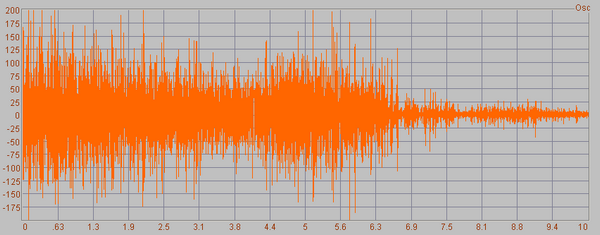
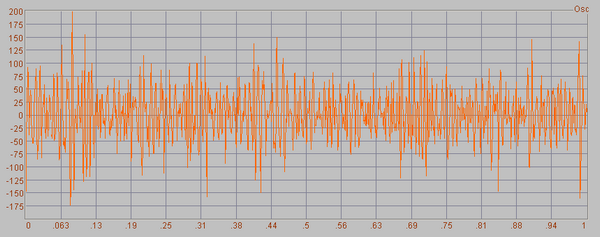
The oscillations are quite fast – up to several hundred cycles per second (or Hertz). The figures below show what a “raw” EMG trace looks like. The amplitude of this signal (or size in the vertical dimension) is what correlates to muscle tension.
The first figure shows 10 seconds worth of EMG data.
The second figure, below, shows the raw EMG trace on a shorter time scale of 1 second - in other words a zoomed in view. You can see it is one continuous trace. You can also see the trace is an oscillation - moving above and below the zero line. If we "zoomed in" even further (to an even shorter time scale) we would see the frequency of the oscillation is quite variable.
EMG Signal Processing
For practical purposes we aren't really interested in the oscillation. Rather, we want to quantify muscle tension as a number that gets larger when we tighten the muscles and smaller when we relax. This section is a (somewhat technical) description of how to derive such a number. Remember you don't need to understand the details to make practical use of the application.
In general, oscillating signals are characterised or quantified in terms of frequency (number of cycles per second, in Hertz) and amplitude (the “height” of each cycle). For EMG (as for EEG and other biosignals) neither of these is fixed and stable.
There are two key methods for processing such signals, these are digital filtering and Fourier analysis (known variously as spectral analysis, Fourier transforms, Fast Fourier Transforms or FFT).
These digital signal processing methods (filtering and FFT) are described in this article. (TO_DO add link)
Here I will summarise with a few key points
- Complex oscillating biosignals having variable frequency can be treated as if they were made up of multiple sine-wave oscillations added together. These components have a fixed or stable frequency and amplitude, at least for the short period of time that analysis is computed for. (Note this doesn't necessarily mean
- A useful analogy is that white light can be considered as a mix of components having different frequencies (and hence different colours).
- Spectral analysis works like a prism does for white light - it separates out the whole spectrum of light colours.
- Digital filtering works like a coloured glass does for white light - it allows through one frequency / colour and blocks the rest.
In EMG signal processing, we are particularly interested in the frequency range 100-200 Hz - the actual range of EMG is wider but this range is representative and a useful way of standardising. It has the advantage of excluding interference from mains electricity (which is at 50 or 60Hz).
In Mind-Body Training Tools, the user can opt to use either DSP method (filtering and FFT) as the basis for EMG biofeedback. (Most other EMG biofeedback software uses digital filtering.) Conceptually, filtering picks out the amplitude of the “biggest” component of the raw EMG signal, while FFT delivers an average of the components in our 100-200 Hz range.
It's important to be aware that the two methods involve quite different mathematics and don't deliver the same number.
In the case that the filtering method is used, a second step is to derive an amplitude of the filtered signal. For this we can use either peak-to-peak amplitude or RMS amplitude. Peak-to-peak can be considered as peak-to-trough. For further information in RMS see the Wikipedia entry for RMS.
We can think of RMS as the average height above the zero line of the trace. (The troughs, or the times when the trace goes below the centre line, are "rectified" or flipped over so they're above the zero line.) RMS works out to be roughly a third of the full peak to trough amplitude.
In biofeedback we are primarily interested in relative changes over time, so the differences between the amplitude measures are not really significant.
The further step in quantifying EMG for biofeedback is to average out the amplitude measure, over some period of time. Averaging over a period of something like 1 second smooths out this variability and gives us a more meaningful measure, or one that correlates to our subjective experience of muscle tension and changes in muscle tension.
Working with EMG in Biofeedback
This section explains how EMG biofeedback training is useful, particularly within a context of mindfulness / meditation practice. It also discusses the two most common sensor placements and their relative merits.
In biofeedback you learn to connect the external feedback to your internal (subjective) experience – particularly bodily experience. Muscle tension offers a very useful window on the mind-body connection: many of our muscles are directly consciously controllable, but on the other hand they also respond quite automatically to emotions, thoughts and memories. Broadly speaking, we tend to tighten up in response to emotions such as anxiety and anger – even very brief and subliminal emotions. Any sense of emotional threat tends to cause us to literally brace ourselves, as though it were a physical threat. 'Inner resistance' is a term I use for subtle forms of this. It means not wanting some aspect of our current experience – for example a pain – to be within our awareness. Inner resistance manifests as tension, as though we were attempting to hold the experience at arms length.
Learning to maintain soft relaxed musculature is a powerful strategy for maintaining open, calm and expansive states of mind.
Relaxing muscle tension is difficult for many people, because it's not necessarily easy to be aware of tension in the first place – and also of the effects of your attempts to relax. Awareness is a prerequisite for conscious control. EMG biofeedback helps us develop a much more sensitive awareness of the state of our musculature, on the basis of which we can develop greater skill in relaxing muscles.
An important aspect of meditation practice is to keep the mind stably focused in the present moment. If you've had any experience with mindfulness meditation you'll know that the mind tends to wander off. The practice of mindfulness is to keep returning to the object of concentration. The key is to notice when the mind has wandered off. This is not easy for most people – it is common to spend quite a few minutes at a time in distraction.
Biofeedback can help with mindfulness practice by flagging when we have become distracted – at least insofar as distractions are manifested as subtle changes in the body's physiological state. In other words it functions as a distraction detector. We can characterise different forms of distraction – one useful distinction is between low-energy, slothful and sleepy states, versus high-energy, agitated states. The latter may be emotionally arousing distractions such as anxious worrying or resentment, or they may be forms of sensual craving, or they may be subtle urges to activity such as restlessness, or planning what you're going to do later on. Whatever the case, this kind of high-energy distraction tends to manifest as higher muscle tension, meaning that EMG biofeedback is useful at flagging this kind of state. By contrast low-energy distractions such as day-dreaming or sleepiness don't create muscle tension.
Sensor location is a key decision in EMG biofeedback. Different placements can bring out different aspects of the mind-body relationship. The two placements I commonly use are (i) wrist placement and (ii) forehead placement.
Wrist Placement
Placing one active sensor on each wrist picks up tension in the arms, hands and shoulders – especially the latter two. Also tension in the upper chest and neck has an influence. (The third sensor or ground can go on either wrist. See the Hardware guides for more information.)
Emotional defensiveness, inner resistance and wariness can all subtly manifest as tightness in these areas, mostly commonly around the shoulders, but also in the hands and any of the muscles detected with this placement.
EMG & Breathing
With the wrist to wrist placement, rhythmic patterns related to the breathing typically show up. This is because the shoulders and upper chest are often involved with breathing. The figure below shows an example.
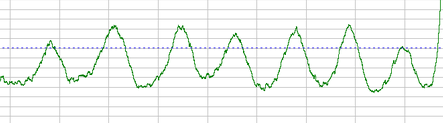
This makes the wrist placement very useful for practising mindfulness of breathing. The more the upper chest and shoulders are involved, the more prominently the rhythm shows up in the EMG. Conversely relaxed abdominal breathing shows as a much smaller variation. This makes sense because movements of the diaphragm and lower intercostal muscles, which are active in abdominal breathing, are not really picked up picked up by this placement.
The breath is subtly reflective of our mental and emotional state. Chest-based breathing is suggestive of the kind of emotionally defensive states I've alluded to, whereas abdominal breathing is more open and calm. For many people, chest-based breathing has become an ingrained habit, but one which can quite easily move towards more natural abdominal breathing with mindfulness practice.
To get a meaningful measure, the arms should be loose and by the sides with the hands probably on the lap. Holding the arms up or clenching the hands will give much higher readings. Fully relaxing all these muscle groups will give an EMG reading of around 1 microvolt – but not much less. A typical everyday state might give around 3-6 microvolts. Higher readings (10-20 microvolts) are common and may reflect stress and emotional tension. (If you're using gel-free snaps – see the Hardware Set-up Guides for more about this – bear in mind that the readings are less accurate so interpret the numbers more loosely.)
Forehead Placement
All three sensors are placed on the forehead, with the ground in the middle. This placement picks up tension from anywhere in the head, the jaw being an especially powerful contributor. Even the tongue can contribute. However, breathing makes no significant contribution.
With this placement the numbers are generally smaller, compared to the wrist to wrist placement. Fully relaxing all the muscles of the head will give a reading of around 0.5 microvolts, perhaps slightly less. Everyday states are typically around 1-2 microvolts.
Again stress and emotions are likely to be reflected in higher tension at this placement. Facial expression is a natural part of emotion. Even fleeting and barely-noticed emotions – so-called micro-emotions – can be detected.
The forehead placement also throws useful light on thought processes. Inner dialogue seems to involve subliminal use of the speech muscles – those in the jaw, lips and even the tongue. Activity in these muscles is easily registered with the forehead placement. To an extent, fully relaxed facial musculature is incompatible with maintaining inner dialogue.